
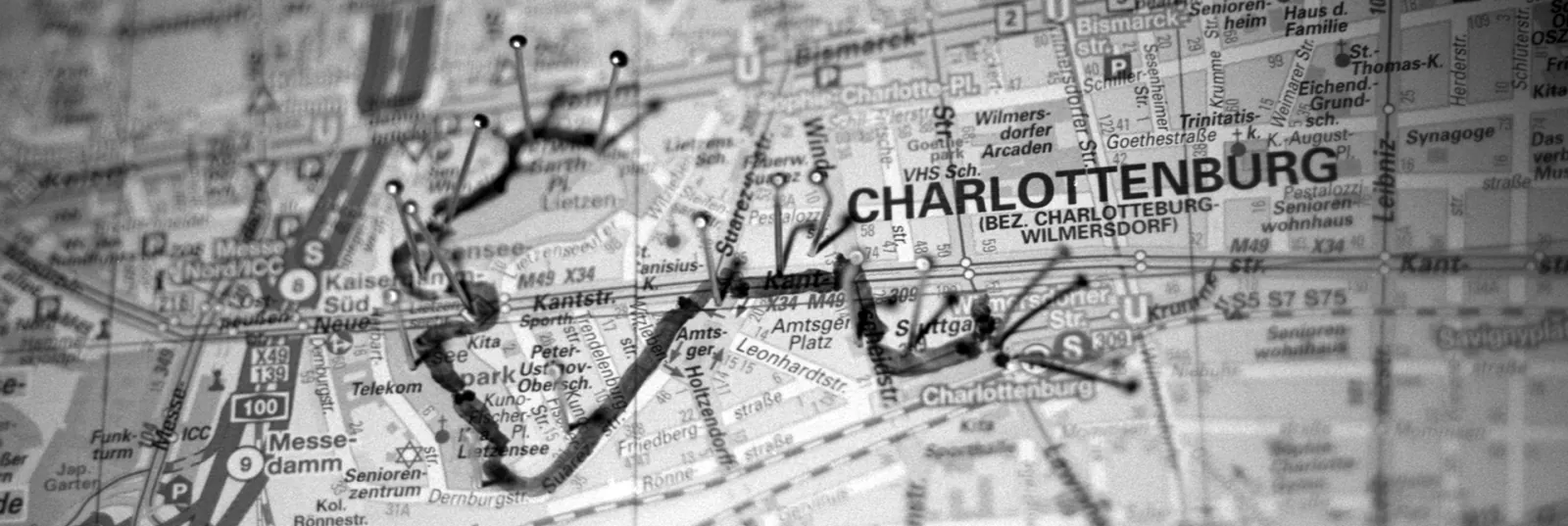
I have lived in Berlin for twenty-three years, most of them here in Charlottenburg, long enough to know the palace is one entrance to the district, not the whole district. TX003 takes that door. TX001 slips in farther south, through the Cyrillic station shop, the tiny cinema, the Persian literary café, the bronze knot opposite the courthouse and the concrete banana that has waited beneath the railway without a label, a purpose or the slightest embarrassment.
Why walk Charlottenburg?
Charlottenburg refuses a single route. TX003 will head to the Palace; TX001 begins farther south and closer to the pavement. We follow Stuttgarter Platz, Kaiser-Friedrich-Straße, Kantstraße and the antique mile of Suarezstraße to the edges of Lietzensee, reading the neighbourhood as an archive that still buys groceries, argues about façades and occasionally leaves its furniture on the corner.
Old residents and newcomers share these markets, shops, cafés and green spaces. Cross against the light and you may receive the Charlottenburger face of judgement, an archetype both maligned and misunderstood. It looks severe, but may only be checking whether you noticed the bicycle. A Russian night shop, Kommune Eins, an Iranian bookshop and a used-record oracle belong to the same local weather system.
Seven threads, and one or two loose wires
- The banana and the Russian outset. We begin beneath the railway at an enigmatic concrete banana. It explains nothing. Across from it, the Russian shop keeps very different hours from respectable Charlottenburg and contains better pickles.
- Nabokov and the future value of trifles. At Stuttgarter Platz, Nabokov’s A Guide to Berlin becomes our operating method: notice the pipe, button or ticket machine a conventional guide would discard before posterity desperately wants it back.
- Political theatre and a wall that lost an argument. Kommune Eins turned private life into public performance. Farther along, the HappyGoLucky façade was returned from psychedelic colour to heritage-approved grey. Berlin contains many revolutions; some end with a paint specification.
- A cinema fitted to the street. Klick Kino carries the memory of the Ladenkino: small, independent and easy to pass unless somebody whispers at exactly the right doorway.
- Cursed merchandise and exile languages. At Music Train Records, I was once refused a Laurie Anderson album because I was “not ready.” Next door, the Hedayat bookshop and café keeps Iranian literature circulating. One shop diagnoses the customer; the other resists the censor.
- Memory under civic supervision. Vadim Sidur’s Treblinka faces the courthouse; along the antique mile, Elfriede Scholz’s story shows how an ordinary sentence in an ordinary room could become evidence. Here the route lowers its voice.
- The lake changes the rules. Galleries, buried pipes and a tiny guerrilla plaque lead into the history and folklore of Lietzensee. By Tree 418 we have acquired a blind owl, Aleister Crowley and rumours of spectral infrastructure. The park remains publicly accessible; the dimension beyond keeps irregular hours.
Now turn left at every church you encounter.
Choose the right listening format
For the complete field experience
The published VoiceMap edition is the cleanest way to walk outdoors. GPS-triggered playback and turn-by-turn directions let you put the phone away; my voice finds you when the location has something to confess.
For research before or after the walk
The published TX001 footnotes are the companion archive. Each permalink isolates a stop with its transcript, field cue, location, media and references. Use them to check a name, separate a document from a rumour, or follow a thread after the walk has officially denied responsibility for it.
For a free browser preview
The Berlin Footnote route page keeps the map, bilingual audio and chapter list together. Stay beyond the canonical route for the bonus transmissions: a Nabokovian refrigerator, Georg Heym, the former Reich Military Court, Renate von Charlottenburg and an unofficial initiation ritual. They did not all fit politely inside the tour, which is partly why they are worth hearing.
Walk TX001
Put the route in your pocket
Open the official VoiceMap edition for automatic GPS playback, offline access and walking directions. Then return to the footnotes for photographs, transcripts, sources and whatever continued branching while we were outside.
Planning the walk
Allow at least 75 to 90 minutes even though the audio is shorter. Traffic lights, bookshops, galleries and lakes have no respect for running time. Around the station and road crossings: phone away, shoulders down, eyes open. Leave enough ambient sound to hear bicycles, cars, dogs and the e-scooter materialising behind you at the least narratively convenient moment.
The route is linear. S Charlottenburg is the easiest arrival; the Kleine Kaskaden connect back toward Sophie-Charlotten-Straße and Kaiserdamm. Independent venues keep independent hours, so a locked door is not a failed walk. It is merely Berlin maintaining editorial control.
Sources and further reading
- Berlin Footnote: TX001 route and post-tour transmissionThe bilingual route audio, chapter map and the bonus files that continue after the canonical walk.
- Berlin.de: Charlottenburg district portraitOfficial overview of the district, its neighbourhoods and green spaces.
- Bezirksamt Charlottenburg-Wilmersdorf: KantstraßeOfficial street history and route landmarks from Breitscheidplatz to Amtsgerichtsplatz.
- Library of Congress: Russian Émigré CultureScholarly context for Russian cultural and publishing life in 1920s Berlin and Charlottenburg.
- Berlin.de: Vadim Sidur’s TreblinkaOfficial documentation of the sculpture and memorial at Amtsgerichtsplatz.